
Outdoor work safety
in Australia: the 2026 numbers
Two point seven million Australians earn a living outside. They account for about four in five workplace deaths. Every figure below is traced to a named public source and dated, so you can check it.
This page answers the questions people most often ask about outdoor work safety in Australia. For the full report see The State of Outdoor Work, or the technical edition with peer-reviewed citations and methods.
How many Australian workers die at work each year?#
188 Australian workers died from traumatic injuries at work in 2024, a rate of 1.3 deaths per 100,000 workers. That is down from 200 in 2023 and 24 per cent below the 2014 rate of 1.7. Around 150 of those 188 deaths, or 79.8 per cent, occurred in the five industry divisions where most frontline work is done outdoors.
The national fatality rate has genuinely improved, falling 24 per cent since 2014. But the decline has flattened, and it is unevenly distributed. Serious injury claims have moved the other way entirely, rising 34.5 per cent over the same decade.
How many Australians work outdoors?#
About 2.7 million Australians work in the four largest predominantly outdoor industry divisions: construction, transport, agriculture and mining. That is 17.9 per cent of the workforce. Adding electricity, gas, water and waste services brings it to roughly 2.86 million. Outdoor work is not counted directly by any Australian statistical agency, so every figure of this kind is an approximation.
The Australian Bureau of Statistics classifies employment by industry and by occupation. Neither classification asks whether the work happens outside. The workable approximation is to take the industry divisions in which most frontline work is performed outdoors, and then be honest that it over-counts office staff inside outdoor industries and under-counts field workers inside indoor ones.
An independent cross-check supports the range. The Australian Work Exposures Study, fielded in 2011 and 2012, found 22 per cent of Australian workers were exposed to solar ultraviolet radiation in the course of their work. That is an exposure measure rather than an industry one, and it lands slightly above the industry-based estimate, which is what you would expect once you add the outdoor workers scattered through nominally indoor divisions.
Which Australian industry is the most dangerous to work in?#
Agriculture, forestry and fishing has the highest work fatality rate in Australia at 13.7 deaths per 100,000 workers in 2024, more than ten times the national rate of 1.3. It also records the highest serious claims frequency rate of any industry at 10.0 claims per million hours worked, 46.9 per cent above the national average.
Scroll the chart sideways to see all of it
Counts reward large industries. Rates reveal danger. Construction records the third-highest number of deaths at 37, but a comparatively modest rate of 2.8 per 100,000. Agriculture records more deaths, 44, at almost five times the rate. A regulator allocating inspectors by headcount goes to construction sites. A regulator allocating by risk per worker goes to farms.
What kills outdoor workers in Australia?#
Vehicles and moving plant. Vehicle incidents caused 79 of the 188 Australian worker deaths in 2024, or 42 per cent, and at least one vehicle was involved in 66 per cent of all worker fatalities. Falls from a height caused 24 deaths and being hit by moving objects caused 17. Two of those three categories involve a worker on foot: someone walking across uneven ground, or standing in the path of a machine that is already moving.
Scroll the chart sideways to see all of it
These are not deaths caused by other road users. They are caused by conditions an employer can influence: rostering that produces fatigue, vehicles without rollover protection, terrain that has not been assessed, and lone work without a check-in protocol.
How many serious workers compensation claims are made in Australia?#
There were 146,700 serious workers compensation claims in Australia in 2023-24, meaning claims involving at least one working week of time lost. That is more than 400 every day, and a rise of 34.5 per cent over the decade. The median serious claim involves 7.4 weeks off work and $16,300 in compensation paid.
| Industry division | Serious claims | Frequency rate | Median weeks lost | Median paid |
|---|---|---|---|---|
| Construction | 17,600 | 9.3 | 8.4 | $20,000 |
| Transport, postal and warehousing | 10,400 | 9.0 | 8.8 | $20,700 |
| Agriculture, forestry and fishing | 3,800 | 10.0 | 6.4 | $14,300 |
| Mining | 3,300 | 6.7 | 11.1 | $36,400 |
| Electricity, gas, water and waste | 1,500 | 6.0 | 7.5 | $19,900 |
| All Australian industries | 146,700 | 6.8 | 7.4 | $16,300 |
Frequency rate is serious claims per million hours worked, which corrects for differences in working hours between industries. Claim counts and frequency rates are 2023-24 preliminary. Median weeks lost and median compensation are 2022-23, the most recent non-preliminary period, because some 2023-24 claims remain open.
How many people die on Australian farms each year?#
AgHealth Australia recorded 72 on-farm deaths in 2024, well above the five-year average of 53, alongside 133 serious non-fatal injuries. Side-by-side vehicles caused 14 deaths, quad bikes 10 and tractors 8. Farm injury and death cost Australia about $355 million a year in death and injury compensation, of which roughly $300 million is work-related.
Read the farm figures carefully
Safe Work Australia counts workers. AgHealth Australia counts everyone who dies on a farm, including children, family members and bystanders, drawing on media reports. The two datasets are not equivalent, and media-derived surveillance is sensitive to reporting intensity, so part of the jump from 32 reported deaths in 2023 to 72 in 2024 may reflect better capture rather than a doubling of real incidents. The direction is nonetheless consistent with the compensation data, and the vehicle concentration matches the national mechanism data exactly.
Is heat a legal work health and safety risk in Australia?#
Yes, but there is still no national heat standard. Safe Work Australia publishes only a guide, and as at August 2026 the Australian Capital Territory is the sole jurisdiction with an approved code of practice on extreme temperatures, in force since 14 November 2025. Heat is nonetheless covered by the general duty to manage risk, and the ACTU began campaigning for national heat rules in February 2026.
Heat harm is badly under-recorded, and not because it is rare. Heat degrades judgment, coordination and reaction time long before it produces a diagnosable illness. A heat-impaired worker who then falls, is struck by plant, or rolls a vehicle is recorded as a fall, a struck-by, or a vehicle incident. Heat sits upstream of a great deal of harm it never gets counted for.
The Australian Government's first National Climate Risk Assessment, released 15 September 2025, named mining, construction, agriculture and power generation and transmission as the sectors most exposed to heat-driven labour productivity loss. It projected between 700,000 and 2.7 million additional working days lost to heatwaves every year by 2061, and a reduction in national economic output of $135 billion to $423 billion by 2063.
What are the biggest work health and safety changes facing Australian employers in 2026?#
Three. From 1 July 2026 New South Wales codes of practice became enforceable under section 26A, so failing to follow a code is itself a breach rather than merely evidence of one. From 1 September 2024 the crystalline silica substance rules extended to all materials containing 1 per cent or more silica, capturing concrete cutting, excavation, tunnelling and road construction. And industrial manslaughter is now an offence in every Australian jurisdiction, with the Commonwealth and South Australian offences commencing 1 July 2024.
The direction of travel across every jurisdiction is consistent: broader duties, higher penalties and personal accountability for officers. Industrial manslaughter offences reach officers personally, not just the corporate entity, and a director who cannot demonstrate due diligence carries individual criminal risk.
Does mobile phone use cause workplace accidents in Australia?#
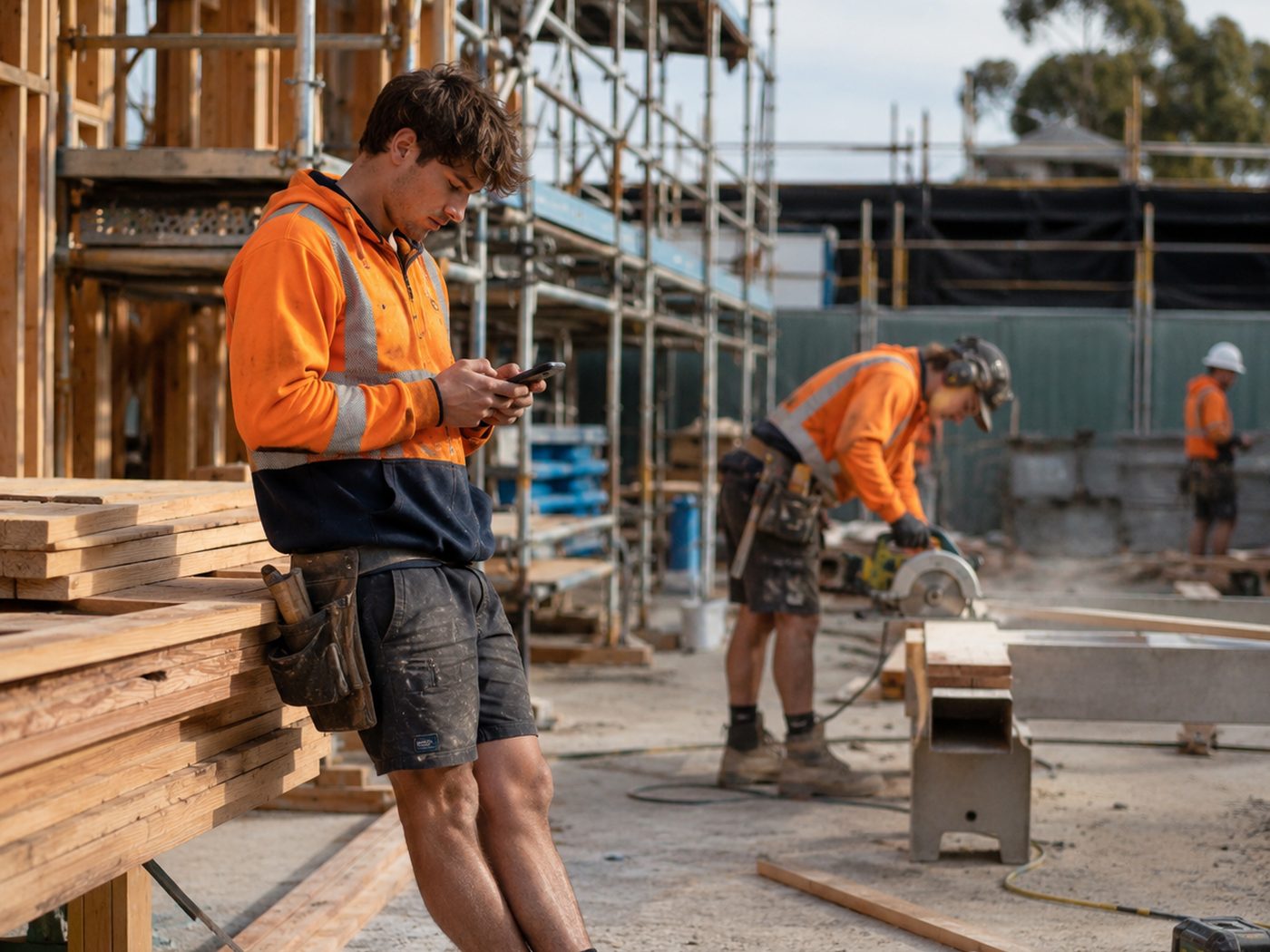
No Australian study has measured phone use in outdoor work, so the honest answer is that it is unproven in that setting. What is established is that handheld phone use impairs the specific capabilities behind Australia's three largest harm mechanisms: hazard detection while driving, balance recovery while walking, and awareness of moving objects while on foot. An Australian study of 50 adults found texting while walking significantly impaired balance recovery during a slip, cutting walking speed from 1.06 to 0.80 metres per second and increasing step time variability from 80.8 to 128.9 milliseconds.
The Australian result is from Pelicioni and colleagues at the University of New South Wales and Neuroscience Research Australia, who walked 50 adults across a perturbation walkway with controlled slip hazards. Texting had no significant effect during normal walking or when a hazard was merely anticipated. It mattered at the moment the slip actually occurred. Falls on the same level account for 68.3 per cent of Australia's 32,000 annual falls claims.
Separately, a Monash University Accident Research Centre study observed 20 per cent of pedestrians using smartphones while crossing roads in Melbourne, and recorded significantly higher rates of near misses and collisions among them. Being hit by moving objects killed 17 Australian workers in 2024 and generated 23,400 serious claims.
The gap between those findings and an Australian worksite is real and we do not paper over it. The technical edition sets out what a study to close it would look like.
Should employers measure phone use on site?#
On the evidence, yes, and for two reasons that are worth separating. The first is that handheld phone use measurably degrades hazard detection, balance recovery and awareness of moving objects, which are the three capabilities standing between an outdoor worker and the mechanisms that cause most Australian workplace harm. The second is that nobody currently knows how much of it happens, so no employer can tell whether their site is unusual or ordinary. Measuring it is the only way to find out, and a measurement that workers can see for themselves is far more likely to change behaviour than a rule nobody enforces.
There is a version of this that goes badly, and it is worth naming. A system that exists to catch people out will be resented, worked around, and eventually switched off, and the research on workplace monitoring is unambiguous that broad surveillance aimed at individuals produces more gaming rather than less. The version that works is narrower and duller: measure one thing, bound it to the shift, show the worker their own number before anyone else sees it, and let the crew compare itself against its own past rather than against a manager's expectation.
That is the design PocketMode is built around, and it is why the measurement sits inside a rostering app rather than a safety dashboard. A worker opens it to check next week's shifts, to see the hours they actually worked, and to know whether tomorrow is going to be too hot to be outside at two in the afternoon. The attention signal is one line in a tool they already had a reason to open.
What is the single highest-yield safety action for an outdoor employer?#
Treat vehicles as the primary fatal hazard rather than a secondary one. A vehicle was involved in 66 per cent of Australian worker deaths in 2024 and 72 per cent of those were single-vehicle incidents, which are the incidents an employer can most directly influence through rollover protection, driving-hour limits, terrain assessment and journey check-ins.
After vehicles, the highest-yield actions are a written heat procedure with defined trigger conditions and mandatory rest cycles, closing the sun protection gap (only 8.7 per cent of exposed Australian outdoor workers are fully protected, though about 95 per cent use something), and giving psychosocial hazards the same documented risk assessment as physical ones. Mental health claims now cost a median $67,400 and 35.7 weeks each, more than four times the cost and nearly five times the time of the average claim.
What a rostering app has to do with any of this
Almost everything on this page is, underneath, a scheduling problem wearing safety clothing. Heat illness is a question of what time the crew started and how long they stayed out. Fatigue is a question of how many days in a row somebody has been on. Lone working is a question of who was rostered where. Being struck by a vehicle is partly a question of how many people were on foot in a yard at the moment the truck reversed. The regulator writes these up as hazards, but the employer experiences all of them as decisions made on a Sunday night about who works when.
That is why PocketMode is a rostering and timesheet app first. The safety layer is not bolted onto a scheduling product for marketing reasons. It is that the roster is where the exposure is actually created, so the roster is the only sensible place to manage it.
The practical version is unglamorous. You publish shifts further ahead, so people can plan their lives and turn up rested. You can see at a glance who has worked eleven days straight. You get a heat and weather warning against a specific site on a specific morning, in time to move the start rather than in time to write an incident report. Your timesheets come from a geofence that runs for the length of the shift instead of a clock-in that people forget, so the record of who was where is accurate enough to be worth something afterwards. And the same app that already knows all of that can take a near-miss report in twenty seconds, anonymously if that is what it takes to get it.
What happens to this data, and who benefits
Every figure on this page came from a source that counts harm after it has already happened. Australia has an excellent record of the aftermath and almost no record of the conditions that produced it. Nobody knows what the weather was doing on the day of an incident, how long that crew had been rostered on, whether the worker had been walking uneven ground for six hours, or how many near misses preceded the one that finally landed in the claims data.
That is the gap a rostering app is unusually well placed to close, because it is already holding the roster, the hours, the location, the weather forecast and the shift pattern for reasons that have nothing to do with research. Add an anonymous way to report a near miss and you have, for the first time, the two halves of the picture in the same place: what the conditions were, and what nearly went wrong.
Aggregated across enough crews and enough seasons, that becomes a longitudinal dataset on outdoor work that does not currently exist anywhere in Australia. It would tell insurers which conditions actually predict claims, tell employers which of their own patterns are dangerous, and tell workers something they have never been given: an honest, personal account of their own hours, their own exposure, and their own risk.
The benefit to the person carrying the phone has to come first, or the whole thing is just surveillance with a research justification attached. So it does. A worker gets shifts published earlier, a timesheet they do not have to argue about, a warning before a dangerous afternoon rather than after it, and a private view of their own patterns: hours, days on, time on foot, step count, time spent in the heat. None of that requires anyone else to see their individual data, and none of it has been possible until phones became good enough sensors to carry the load without anyone noticing.
Where these numbers come from#
- Safe Work Australia, Key Work Health and Safety Statistics Australia 2025, October 2025. Source for all fatality and serious claims figures. data.safeworkaustralia.gov.au
- Australian Bureau of Statistics, Labour Account Australia, March quarter 2026. Source for employment by industry division. abs.gov.au
- AgHealth Australia and AgriFutures Australia, Non-intentional farm-related incidents in Australia, annual statistics 2024. aghealth.sydney.edu.au
- Mesa-Castrillon C, Peachey K-L, Lower T. Farm injury deaths and workers' compensation claims in Australia and their economic costs. Australian Journal of Rural Health 2025;33(5):e70087. doi.org/10.1111/ajr.70087
- Australian Government, National Climate Risk Assessment, September 2025. dcceew.gov.au
- Carey RN, Glass DC, Peters S, Reid A, Benke G, Driscoll TR, Fritschi L. Occupational exposure to solar radiation in Australia: who is exposed and what protection do they use? Australian and New Zealand Journal of Public Health 2014;38(1):54-9. doi.org/10.1111/1753-6405.12174
This page synthesises publicly available Australian government and research data. It is general information about workplace safety trends and is not legal advice. Penalty figures, regulatory obligations and code of practice requirements vary by jurisdiction and change frequently. Verify current requirements with the work health and safety regulator in your jurisdiction before relying on anything here.
Read the whole thing#
The State of Outdoor Work is a 40-page report on the workforce, the hazards, the compliance floor and what employers can do this quarter. The technical edition adds full methods, limitations and peer-reviewed citations.
How to cite this
PocketMode (2026). Outdoor work safety in Australia: the 2026 numbers. Retrieved from https://www.pocketmode.com.au/research/outdoor-work-safety-australia/